
Reviewed · WEST COAST TOURS
Doha: Richard Serra Sculpture, Zekreet and West Coast Tour
Richard Serra’s East-West/West-East is the star here: four huge steel plates set across a broad stretch of Qatar’s western desert. The sculpture feels almost startlingly simple, yet its scale only makes sense once you are standing beside it. I like that this tour pairs serious modern art with Qatar’s odd rock formations, and I like the chance to see the Al Shahaniya camel-racing track along the way.
The main tradeoff is pace. Four hours covers a lot of ground, and some stops are short. The camel track may also be quiet or closed for racing during Ramadan, so you should book this for the mix of places, not for a guaranteed race.
Key points to know before you go
- Richard Serra’s giant steel plates make the long drive west worthwhile, especially near sunset when the light shifts across the desert.
- Zekreet’s mushroom-shaped limestone rocks were formed by wind and are among Qatar’s strangest natural sights.
- The Al Shahaniya camel track offers a look at a sport with a major place in Gulf culture, though active racing is not guaranteed.
- Zekreet Fort is a simple ruin rather than a restored museum, but it gives you a fine view over the surrounding desert and old settlement remains.
- A private group option lets you spend more time at the places that interest you, with guides such as Sajid, Akhtar, Zia, and Usman praised for local insight and photography.
- The $32 price is strong value if you want transport, a 4WD, refreshments, an English-speaking guide, insurance, and several distant sights in one half-day.
Why this west coast trip is worth your half-day
Doha is polished, modern, and easy to visit in a short stay. Qatar’s west coast gives you a different picture: open desert, wind-cut limestone, a weathered fort, working camel facilities, and one of the country’s best-known pieces of contemporary art.
I see this as a good counterweight to museum visits and city tours. You are not simply ticking off attractions. You are watching the land change as the road leaves Doha, then seeing how artists, camel owners, and earlier settlements have all used this dry western region in different ways.
The tour earns a current rating of 4.8 from 71 posted ratings, with repeated praise for punctual pickup, comfortable vehicles, helpful guides, local explanations, and photographs. Guides named in the feedback include Sajid, Akhtar, Zia, Usman, Anwar, Adil, Junaid, Nasir, and Abdur Rahman. The exact guide is assigned by the operator, but the pattern is clear: expect an English-speaking host who does more than point at the sights.
More west coast trips:
- Qatar West Coast tour to Richard Serra Sculpture and Mushroom Rock Formation
★ 5.0 · 153 reviews - Qatar West Coast tour, Zekreet, Richard Serra Sculpture, Mushroom Rock Formation
★ 5.0 · 150 reviews - Doha: West Coast Qatar Tour, Sculptures, Camel Racing track
★ 5.0 · 111 reviews
From Doha to Al Shahaniya in an air-conditioned 4WD
Pickup is available from Doha hotels and the airport. The first drive takes about 20 minutes in a modern, air-conditioned 4WD or SUV, with water and refreshments provided.
That vehicle matters. The route includes off-road driving around Zekreet, and a regular city car would not be suitable for the full trip. Air conditioning also makes a difference in Qatar, particularly in the warmer months. You will spend close to an hour driving between the main stops, so a comfortable vehicle turns what could be tiring transfers into useful time with your guide.
The tour is listed at four hours. That is enough for a strong first look at the west, but not enough for long walks, a relaxed picnic, or a detailed exploration of every site. If you have a private group, you can ask to adjust the amount of time at each stop. One visitor specifically appreciated being able to control the pace, which is useful if photography is important to you.
Al Shahaniya Camel Racetrack: a quick look at Gulf sport
The first main stop is the Al Shahaniya Camel Racetrack, reached after the initial drive from Doha. You have about 35 minutes for photographs, a walk, and views around the facility.
Camel racing is one of the most prominent racing traditions in the Middle East, and the stop gives you a useful cultural frame before the desert scenery takes over. This is not presented as a full race-day program. Think of it as a chance to see the setting and learn about the sport from your guide.
Timing matters here. A March visit during Ramadan found the camel racing canceled, so active racing should never be treated as guaranteed. The facility may still be interesting, but your experience could be limited to the track, buildings, and surrounding views.
I would keep this stop in perspective. If you are fascinated by regional sports, it may be one of the most meaningful parts of the morning. If your main goal is Richard Serra or the rock formations, the track is a brief introduction rather than the heart of the tour.
Zekreet’s mushroom rocks and off-road desert
After about 40 minutes of driving, you reach Zekreet for roughly 30 minutes of off-road adventure, sightseeing, walking, and scenic driving. This is where Qatar’s western desert becomes visually strange and memorable.
Strong winds have shaped the soft limestone into mushroom-like formations. Some rocks look as if narrow stems are holding up broad caps. Their unusual shapes are not decorative or man-made, yet they can seem almost arranged for a surrealist film set.
Your driver takes the 4WD around the rock formations, and you can get out to walk and take photographs. The best part is the scale. Pictures show the shape of one rock, but from the ground you also see the empty space around it, the pale stone, and the wide horizon.
The stop is short, so wear shoes suitable for uneven ground and expect a basic outdoor visit rather than a marked attraction with facilities. Stay close to your guide and vehicle, especially if the group spreads out for photos. Wind and sun can make a short walk feel more demanding than the distance suggests.
The route may also include views toward Zekreet Beach. That adds another texture to the stop, though the supplied schedule gives the main attention to the rocks, off-road driving, and open desert.
More Zekreet and Richard Serra trips:
- West Coast tour, Zekreet, Richard Serra Sculpture, Mushroom Rock Formation
★ 5.0 · 95 reviews - Explore Zekreet: Richard Serra Art & Mushroom Rock Wonders
★ 4.9 · 55 reviews - West Of Qatar, Mushroom Rocks, Camel Racing Track, Richard Serra
★ 5.0 · 33 reviews - West of Qatar Tour || Richard Serra || Mushroom Rock Formation
★ 5.0 · 31 reviews
Zekreet Fort and the remains of earlier settlement
Zekreet Fort follows the rock formations and gives you a look at an older layer of the area. The fort is not a large, restored complex. Much of what remains is simple, weathered, and open to the elements.
That is part of its value. You are seeing a fragment of Qatar’s past in the same setting as prehistoric sites and remnants of old settlements. The fort also offers a good viewpoint over the surrounding desert, so the visit is as much about place as architecture.
Set aside expectations of polished rooms, signs, or a long indoor visit. This is a short, self-guided stop supported by your guide’s explanations. Ask about the fort, the old settlement remains, and how people used this part of the west coast. Guides such as Zia, Anwar, Abdur Rahman, and Junaid were praised for explaining Qatar’s culture and past in a way that added meaning to the drive.
For me, the fort works best as a pause between the natural rock formations and the modern sculpture. It reminds you that this remote-looking area has not always been empty.
Richard Serra’s East-West/West-East sculpture
The tour’s central stop is the Richard Serra installation at GV86+XW Broog. The formal title is East-West/West-East, though it is sometimes written in descriptions with the words reversed.
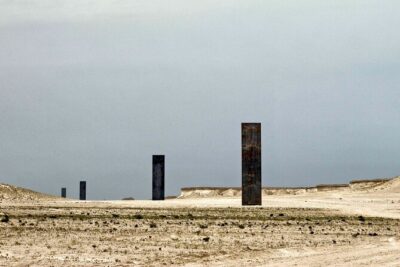
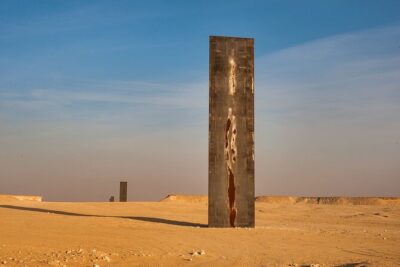
American artist Richard Serra created the work from four enormous steel plates placed in a line across the desert. Each plate is about 14 meters high, and their spacing draws your eye forward through the open terrain. The work is not tucked into a gallery. It is exposed to the sky, wind, heat, and silence.
That setting changes how you read it. The sculpture does not merely occupy the desert. It makes you pay attention to distance, emptiness, and the low horizon. Walk around it rather than taking one quick picture from the vehicle. Look at how the plates frame one another, then turn around and notice how small people appear beside them.
The scheduled visit lasts about 35 minutes, including walking and scenic views. That is enough for photographs and a first impression, though art lovers may want longer. One art-focused visitor used a one-day Qatar stopover for this journey and found the visit especially rewarding, with guide Sajid adding thoughtful discussion and taking carefully composed photographs.
Sunset can be a particularly good time. A November visit was timed for sunset photographs, and another visitor specifically appreciated staying at the sculpture until the light changed. The tour does not promise a sunset departure, so check the start time before booking if golden-hour pictures are a priority.
How the guide can change the experience
The west coast sights are spread out, and much of the value comes from the person behind the wheel. A guide can connect the camel track, the fort, the rock formations, and the sculpture instead of leaving you with four unrelated photo stops.
The strongest feedback centers on polite, flexible service, clear explanations, and help with photographs. Guides named Akhtar, Zia, Usman, Sajid, and Adil were singled out for answering questions, explaining Qatari culture and religion, driving carefully, and taking photos. One guide, Zia, adjusted the pace at individual locations. That matters because the official timing is only a guide, especially for a private group.
You should feel free to say what matters most to you. Ask for more time at the rocks if you want close-up photographs, or at Serra’s installation if you want to study the work. The tour includes an English-speaking guide, but the level of art or historical discussion can vary with the person assigned.
Timing, comfort, and value at $32
At $32 per person, this is a good-value way to reach sights that are difficult to combine without your own 4WD. The price includes pickup and return, transport, water and refreshments, an English-speaking guide, and insurance.
The value is strongest for a short Doha stay, a stopover, or anyone who does not want to arrange a separate desert vehicle. You get several different parts of western Qatar in four hours, with no need to manage directions or off-road driving.
The price is less compelling if you want a slow, specialized art visit. The sculpture receives about 35 minutes in the planned schedule, and the entire trip includes substantial driving. A private group can help, since you may be able to choose how long you spend at each stop, but the basic duration remains four hours.
Pickup is available at hotels and the airport, which makes this practical for visitors with limited time. The activity also offers reserve-now and pay-later booking, plus free cancellation up to 24 hours ahead for a full refund. Those terms are useful if your Qatar plans may shift.
Who should book this tour
I would recommend it most strongly to:
- First-time visitors who want to see beyond Doha in a single half-day
- Stopover visitors looking for a substantial excursion without losing a full day
- People interested in public art, desert geology, and local culture in equal measure
- Photographers who want unusual rock shapes and a dramatic sculpture setting
- Visitors who prefer a private vehicle and a flexible pace
- Anyone who would rather have a local guide explain the route than drive alone
It may be less suitable if you need a fully accessible, paved sightseeing route, since the program includes walking on uneven desert ground and off-road driving. That detail is not presented as an accessibility-focused service, so ask the operator before booking if mobility is a concern.
It is also not the right choice if your priority is guaranteed camel racing. Ramadan can affect racing schedules, and the stop is mainly a sightseeing and photo visit.
Should you book the west coast tour?
Book it if you want Qatar to be more than Doha’s towers and museums. The combination is unusually effective: camel racing, wind-carved limestone, a modest fort, and a major contemporary sculpture all fit into one well-managed half-day.
I especially like the Richard Serra stop and the mushroom rocks. They give you two very different ways to see the west coast, one shaped by an artist and one by nature. The fort adds a useful human link, while the camel track introduces a living sporting tradition.
Go in with realistic expectations. The drive is part of the experience, the schedule is brisk, and the camel track may be quiet. At $32, with 4WD transport, pickup, refreshments, insurance, and a guide included, the tour makes a sensible choice for a first visit or a short stopover. If sunset at Serra’s sculpture matters to you, request a suitable departure time and confirm it before paying.
FAQ
How long does the tour last?
The tour lasts four hours, including pickup, driving between sites, sightseeing, and the return to Doha.
Where does pickup take place?
Pickup is available in Doha, including hotels and the airport.
What vehicle is used?
Transportation is provided in a modern, air-conditioned 4WD vehicle or SUV.
Is the tour conducted in English?
Yes. An English-speaking live guide is included.
Does the tour include camel racing?
The tour includes a visit to the Al Shahaniya Camel Racetrack, with time for sightseeing, walking, photographs, and views. Active racing is not guaranteed, and it may be canceled during Ramadan.
Can I book a private group?
Yes. A private group option is available, and private visits may allow you to choose how much time to spend at each place.
New reviews around Doha
- Katara Cultural Village Doha★ 5.0 · 3 reviews
- Doha: JetSki Experience at Al Corniche With Transfer★ 5.0 · 3 reviews
- Guided Doha Sightseen Tour By Certified Tour Guide (Private Tour)★ 5.0 · 3 reviews
- Doha Highlights Guided Tour With Dhow Cruise★ 5.0 · 3 reviews
- Qatar Transit: Private Doha City Highlights And Dhow Cruise★ 5.0 · 3 reviews
- Doha: Guided City Tour with Pickup and Drop-Off★ 5.0 · 3 reviews
- Exclusive Doha Private Dhowcruise & Cornichewalk With Sunset★ 3.3 · 3 reviews
- Qatar: Paratrike Air Tour with Hotel Transfers★ 5.0 · 3 reviews
West Coast Tours, compared.
Qatar West Coast tour to Richard Serra Sculpture and Mushroom Rock Formation
Read our review →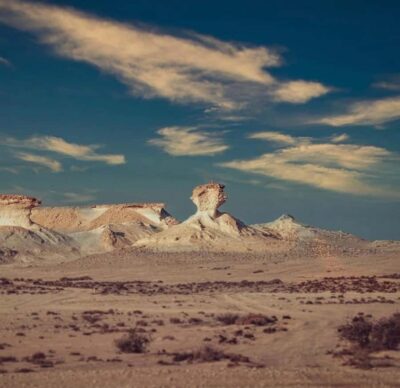
West Coast Qatar Tour, Sculptures, Camel Racing track
Read our review →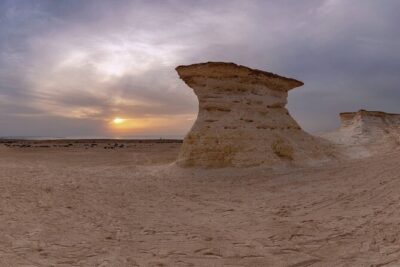
West Coast Tour , Richard Serra Sculpture, Zekreet
Read our review →
Discover Qatar’s Hidden Gems: North & West Coast Private Tour
Read our review →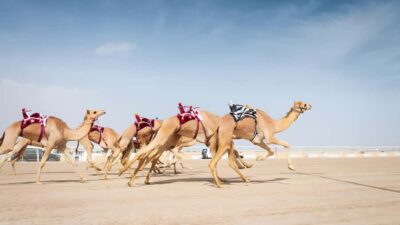
Qatar West Coast: Mushroom Rock & Camel Racing Experience
Read our review →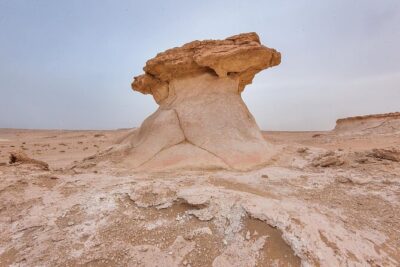
West Coast Tour, Richard Serra Sculptures, RockDunes
Read our review →Browse the lists this tour appears in