
Reviewed · DOHA
Doha: Explore the North and West of Qatar With Transfers
Qatar’s best surprise may be how quickly the city gives way to quiet coastlines, old forts, and open desert. This 7-hour trip takes you far beyond Doha, from Al Khor’s fishing harbour to Richard Serra’s giant steel slabs near Zekreet.
I like the mix of places: Purple Island gives you a short nature walk, while Zubara Fort adds real historical weight. I also like the small-group format, capped at 12 people, and the chance to see camel racing at Al Shahaniya.
The main drawback is the pace. You cover a lot of ground, with several stops lasting only 10 to 30 minutes, so this suits you best if you want a broad introduction rather than long, unhurried visits.
Key points
- A full-day escape from Doha: Travel north and west by air-conditioned 4×4, with hotel pickup and drop-off included.
- Seven very different stops: See a fishing harbour, mangroves, a UNESCO-listed fort, desert rock formations, village ruins, modern art, and camel racing.
- Zubara Fort is the main historical stop: Allow an hour here to understand Qatar’s former trading links and coastal settlements.
- Richard Serra’s artwork needs its setting: The enormous steel plates make more sense when seen spread across the empty desert.
- Small groups keep the day manageable: The tour is limited to 12 people and includes an English-speaking guide and driver.
- Guides add much of the value: Arum and Muzzi are named among the guides connected with recent departures, both noted for lively explanations of Qatar’s past.
Leaving Doha for Qatar’s quieter north
This is the sort of outing I would choose after spending time among Doha’s museums, malls, and modern towers. You get a look at the country outside the capital, where the pace slows and the scenery becomes spare, flat, and striking.
Transport is by air-conditioned 4×4 or SUV. That matters here because the route links distant coastal and desert sites that are not practical to combine on foot or by ordinary city transport. Hotel pickup and drop-off are included, as are bottled water and traditional karak tea.
The listed price is $108 per person. For seven hours of transport, a driver-guide, hotel transfers, and several widely separated sights, that is a reasonable package if you want convenience. You are not paying for a meal, though, so plan around the fact that food is not included.
The group limit of 12 is another useful detail. You will not have the privacy of a private tour, but a small group makes it easier to hear the guide, ask questions, and get in and out of the vehicle without the delays of a large coach.
Other Doha trips that get booked alongside this one:
- Doha: Safari, ATV, Camels, Sandboarding and Inland Sea Tour
★ 4.8 · 5,291 reviews - Doha: ATV, Quad/Buggy Dune Bashing, Camel Ride, Sandboarding
★ 5.0 · 3,784 reviews - Desert safari, Dune bashing, sandboarding, camel, ATV Option
★ 5.0 · 2,826 reviews
Al Khor Harbour and Qatar’s fishing past
The first stop is Al Khor Harbour, about 40 minutes from Doha. You get around 20 minutes for photographs and sightseeing beside the water.
This is not presented as a major museum visit. Its value is the setting and the introduction it gives you to Qatar’s traditional fishing life. The harbour offers a calmer view of the country, with boats and sea views replacing Doha’s towers.
I would treat this as a gentle opening stop rather than a reason to book the whole tour. The short visit gives you time to look around and hear about fishing heritage, but it will not satisfy you if you want a detailed working-harbour tour.
Still, it sets up the rest of the day well. Qatar’s story is not only about recent wealth and modern architecture. Coastal work, trade, and small settlements shaped life here long before the capital’s present-day skyline.
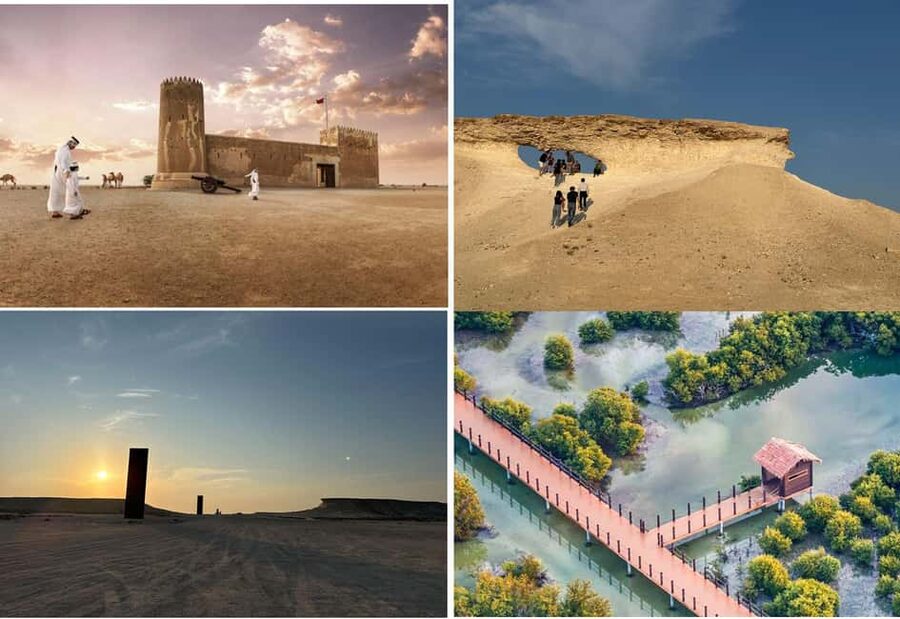
Purple Island’s mangroves and short coastal walk
From Al Khor, you continue to Purple Island for roughly 30 minutes. This stop includes a visit, guided sightseeing, photographs, and a walk along tranquil paths near the mangroves.
The name is a little dramatic, but the place offers a useful change from the harbour. You can look for coastal plants and wildlife while walking through a low-lying natural area. The mangroves and surrounding shoreline show a side of Qatar that is easy to miss if your trip stays inside Doha.
The timing is enough for a taste, not an expedition. Wear comfortable shoes and bring water, even though bottled water is provided. The walk is likely to feel exposed in strong sun, and you should be ready for heat rather than expecting shade throughout.
I like this stop because it breaks up the historical and desert visits. It also gives you a chance to move around before another stretch in the vehicle. If your main interest is birdlife or close study of the mangroves, 30 minutes will feel brief. If you simply want coastal scenery and a short walk, it fits the day nicely.
Zubara Fort, the day’s key history lesson
After another drive, you reach Al Zubara Fort for about an hour. This is the most substantial cultural stop and the place where the route’s historical story comes into focus.
Zubara was once an important trading post, and the fort helps explain Qatar’s links with regional commerce. Your guide can place the site within the wider story of coastal settlements, trade, and the preservation of Qatar’s past.
An hour gives you time to look at the fort, take photographs, and listen without feeling rushed. Compared with the shorter photo stops, this visit has enough space for genuine explanation. If you want the day’s clearest connection to Qatar’s earlier years, this is it.
Do not expect a sprawling complex with hours of galleries. The appeal is the fort’s position, structure, and connection to the former trading town. The guide makes a real difference here. Arum is repeatedly associated with detailed explanations of Qatar’s story, and Muzzi is also noted for making the information engaging. Your assigned guide may differ, but the tour is built around live English commentary rather than a recorded audio track.
The fort is also a good reason to keep your camera ready, though photographs alone will not explain why the site matters. Listen to the context. Without it, you may see an attractive old building and miss the larger story of Qatar’s place in regional trade.
A completely different kind of day, same short drive:
- Qatar Gold Dune Safari, Dune Bashing,Camel Ride,Sand Boarding,Inland Sea Desert
★ 5.0 · 2,807 reviews - Doha: Guided City Tour with Airport and Hotel Pickup
★ 4.9 · 2,357 reviews - Doha :Half Day Desert Safari | Camel Riding | ATV | Sand Surfing
★ 5.0 · 1,907 reviews - Doha : City Tour To All Main Attractions Including Transfers
★ 4.9 · 1,849 reviews
Zekreet’s rock formations and desert silence
The route then turns toward the west and Zekreet. One stop is described as a visit to dramatic rock formations, with about 30 minutes for photographs, sightseeing, and a guided explanation.
Here, weathered limestone rises from the surrounding desert in unusual shapes. The contrast is strong: pale rock, open ground, and a sky that seems much larger than it does in Doha. This is one of the best places on the route for photographs because the setting feels so different from the city.
The stop is not a long hike. You will be getting out, looking around, and walking a little before moving on. That is good news in the heat, but less useful if you hoped to explore the area at length.
I would pay attention to the way the guide describes the rock formations. The shapes are easy to enjoy visually, but the point of the visit is also to understand how the desert environment changes across Qatar. The trip gives you a quick look at that contrast without requiring a separate desert excursion.
Zekreet Village and the remains of a rural settlement
Close to the rock formations, you visit a traditional village area for about 30 minutes. The route includes a photo stop and a visit, followed by a short stop at Zekreet Fort Ruins that lasts about 10 minutes.
The village offers a quieter view of Qatar. Traditional buildings and historic remains give you a sense of rural settlement in a place now surrounded by open desert. It is not polished like a major heritage attraction, and that is part of its appeal.
The brief fort-ruin visit is best understood as an add-on rather than a full archaeological tour. Ten minutes is enough to stop, hear a little context, and take photographs. It is not enough for close examination or an extended lecture.
This is another point where expectations matter. You are not visiting a preserved old town with shops, restaurants, and extensive interiors. You are seeing remnants and traces, with the desert doing much of the visual work. I find that worthwhile if you enjoy places that feel quiet and lightly developed.
Richard Serra’s East-West, West-East in the open desert
The most unusual stop is Richard Serra’s East-West/West-East, a monumental art installation in the desert near Zekreet. Four huge steel slabs stretch across the open setting, creating a bold line through the surrounding ground.
You get about 30 minutes for a visit, a walk, and photographs. The artwork is simple in form but powerful because of its scale and isolation. Serra designed the work to be experienced in relation to the land around it, so the empty space is not a backdrop added for decoration. It is part of the work.
This is not a conventional art museum stop. There are no rooms full of paintings or a long list of objects to inspect. You walk among the slabs, look down their length, and notice how distance and light change your view.
Some people will love the calm, stark setting. Others may find the installation too minimal, especially if they prefer historic buildings or natural scenery. I would keep an open mind and listen to the guide’s explanation. The combination of contemporary art and desert terrain is one of the route’s most distinctive features.
Wear practical footwear here. The stop includes walking on open ground, and the setting may offer little shelter. The tour does not specify the exact walking distance, so comfortable shoes are the sensible choice.
Al Shahaniya Camel Racetrack and a living tradition
The final major stop is Al Shahaniya Camel Racetrack, with about 20 minutes for a visit and photographs. This is where the day shifts from old buildings and natural scenery to a tradition that is still part of modern Qatari culture.
Camel racing is not just a photo subject. It is a deeply rooted sport with a strong connection to the region’s desert life. Seeing the track gives you a way to connect the history discussed earlier with a living practice.
The schedule allows only a short visit, and that is the main limitation. The details provided do not guarantee a particular race or event during your arrival. You may see the track and camels, and the tour describes the possibility of watching racing, but the exact activity can depend on timing.
Even so, this is likely to be one of the most memorable stops for many visitors. The contrast with Doha is immediate, and the desert setting adds to the sense that you are seeing a part of Qatar that a city sightseeing tour cannot provide.
If camel racing is your top priority, ask about the day’s timing before you book. If it is one interesting part of a wider route, the brief visit works well.
How the guide shapes the day
The guide is more than a driver on this trip. You spend many hours in the vehicle, and the route covers places that need explanation. Without clear commentary, some stops could feel like a series of photo locations.
Arum is connected with several recent departures and is praised for explaining Qatar’s story in detail, answering questions, and making the day feel informative. Muzzi is also associated with departures where the explanations were made engaging and easy to follow. The company identifies the guide service as English-speaking.
You should still remember that guide assignments can change. The important point is that the tour includes a live guide rather than asking you to make sense of every fort, ruin, and artwork on your own.
I especially value the human explanation at Zubara Fort and the Serra installation. Both places reward context. The same applies to the camel racetrack, where a short explanation can help you understand why the stop matters beyond taking a picture.
A realistic look at time, comfort, and value
Seven hours sounds generous, but the route includes several long transfers. The schedule lists drives of about 40 minutes between some stops and another 30-minute vehicle journey before the camel racetrack. You should expect a day built around driving between highlights, not a slow walk through one area.
That structure is the price of seeing both the north and west in one outing. On your own, arranging Al Khor, Zubara, Zekreet, and Al Shahaniya would take more planning and navigation. The 4×4, hotel transfers, and guide remove much of that work.
The vehicle is air-conditioned, which is important in Qatar, and bottled water is included. Karak tea is also provided, adding a small local touch. Meals are not included, so check the day’s arrangements with the provider and plan accordingly. The supplied details do not specify a meal stop.
The tour is listed as wheelchair accessible. If you need specific assistance at the rock formations, village ruins, or Serra installation, confirm the practical arrangements before departure, since the schedule includes outdoor walking and uneven desert settings.
Cancellation is free up to 24 hours before the activity for a full refund, and you can reserve now and pay later. Those terms are useful if your Doha plans may shift. Starting times depend on availability, so check the date and departure time before making other arrangements.
Who should book this north and west Qatar tour?
I would recommend it to you if this is your first visit to Qatar and you want more than Doha’s urban sights. It gives you a strong sampler of coastal life, nature, heritage, contemporary art, desert scenery, and camel culture in one day.
It also suits visitors who prefer an explanation with their sightseeing. The guide can connect the places into a story, rather than leaving you with isolated photographs of a fort, a mangrove area, and a sculpture.
You may want a different tour if you dislike long vehicle journeys or need extended time at each stop. Photographers who want patient light and multiple angles may find the schedule too tight. The same is true for serious birdwatchers, archaeology enthusiasts, or art lovers who prefer a specialist visit focused on one subject.
Families and small groups may appreciate the limited group size and private hotel transfers, though the route is still a fairly long day with repeated stops. The air-conditioned vehicle helps, but you will need to be comfortable with a packed schedule.
Should you book it?
Book this tour if you want to see the many faces of Qatar beyond Doha without arranging several separate trips. The strongest parts are Zubara Fort, the stark Zekreet area, Richard Serra’s huge steel installation, and the chance to visit Al Shahaniya Camel Racetrack.
At $108, the value is good for a seven-hour guided outing with 4×4 transport, hotel pickup, water, karak tea, and a group limited to 12. Just keep your expectations realistic: this is a broad introduction, not an in-depth visit at every stop.
Choose it for variety, local context, and efficient coverage. Skip it if you want a slow day, a guaranteed camel race, or long walks at one site.
FAQ
Where does the tour begin and end?
Pickup and drop-off are provided in Doha. The tour returns to Doha after the final stop at Al Shahaniya Camel Racetrack.
How long does the experience last?
The tour lasts 7 hours.
How much does the tour cost?
The listed price is $108 per person.
What transport is used?
You travel in an air-conditioned 4×4 Jeep or SUV.
Is hotel pickup included?
Yes. Hotel pickup and drop-off in Doha are included.
Is a guide included?
Yes. The experience includes an English-speaking guide and driver.
What languages are available?
The tour is offered in English.
How large is the group?
It is a small-group tour limited to 12 participants.
Are food and drinks included?
Bottled drinking water and traditional karak tea are included. Meals are not included.
Can I cancel the booking?
Yes. You can cancel up to 24 hours in advance for a full refund. You can also reserve now and pay later.
New reviews around Doha
- Katara Cultural Village Doha★ 5.0 · 3 reviews
- Doha: JetSki Experience at Al Corniche With Transfer★ 5.0 · 3 reviews
- Guided Doha Sightseen Tour By Certified Tour Guide (Private Tour)★ 5.0 · 3 reviews
- Doha Highlights Guided Tour With Dhow Cruise★ 5.0 · 3 reviews
- Qatar Transit: Private Doha City Highlights And Dhow Cruise★ 5.0 · 3 reviews
- Doha: Guided City Tour with Pickup and Drop-Off★ 5.0 · 3 reviews
- Exclusive Doha Private Dhowcruise & Cornichewalk With Sunset★ 3.3 · 3 reviews
- Qatar: Paratrike Air Tour with Hotel Transfers★ 5.0 · 3 reviews